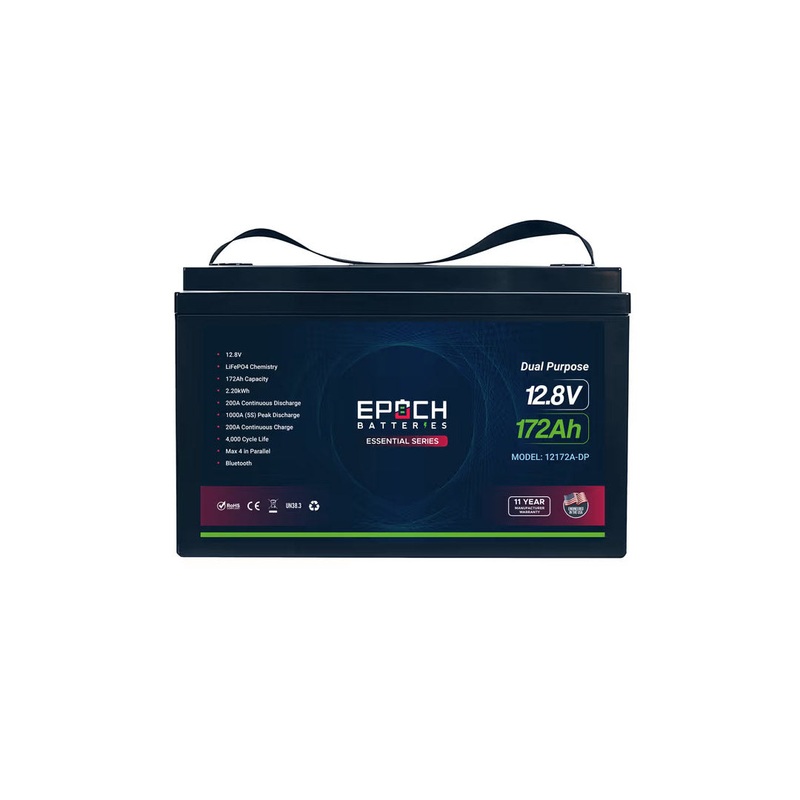
(PRE-ORDER) 12V 172Ah (2.20kWh) Dual Purpose Essential Series – Group 31 LiFePO4 Battery – ETA APR 30
Nutritive
$ 97.76
LiFePO4 Chemistry Cranking Dual Purpose Battery ~ 1000 CCA ~ Compatible with all outboard motors up to 250hp 1,000A @ 5s – Cranking Capability 200A Max Continuous Discharge BLUETOOTH – iOS and Android Apps IP65 Rated, Dust and WATERPROOF Over charge and over discharge protection Over current and short circuit protection High & low temperature disconnects Max (4) in Parallel 4,000 Cycle life & Maintenance-free 11 Year Manufacturer Warranty Specifications ConfigurationCell Configuration:4S1PChemistry:LiFePO4 CurrentAh Capacity:172AhMax Continuous Discharge Amps:200AMax Charge Current Amps:200AMax Discharge Peak Current Amps:1,000A @ 5sSeries | Parallel:Max (4) in ParallelVoltageVoltage:12.8VMax Charge Voltage:15.0VOperating Voltage Range:10.0V – 14.6V TemperatureCharge Temp Range:5C (23F) / 55C (131F)Discharge Temp Range:-20C (-4F) / 60C (140F)Storage Temp:0C (32F) / 35C (95F) Weight & Dimensions Weight:40 lbsLength:12.91(inches)Width:6.22(inches)Height:8.46(inches) Recommended Charge Setting To properly charge your Epoch Batteries, you will want to verify that any charging component in your system is capable of being programmed for the following specifications. Charging components can include, but are not limited to converters, inverter chargers, solar charge controllers, DC to DC chargers, etc. Bulk/Absorption: 14.2V 14.6V Absorption Time: Two batteries in parallel connections require 30 minutes 200Ah Float: 13.4V 13.8V Equalization: 14.4V/ Disabled Temperature Compensation: 0/Disabled Charge Rate: 50% of the battery or battery bank capacity Battery Charge Temperature Range: 32F (0C) to 131F (55C) Battery Discharge Temperature Range: -4F (-20C) to 140F (60C) Cell Charge Temperature: 32F (0C) to 131F (55C) Cell Discharge Temperature: -4F (-20C) to 140F (60C) NOTE: Not all chargers are capable of multistage charging. If yours is not, you will want to verify it can be programmed for the Bulk/Absorption voltage and have the other items mentioned disabled if applicable. Consult your charger’s manual or the manufacturer.