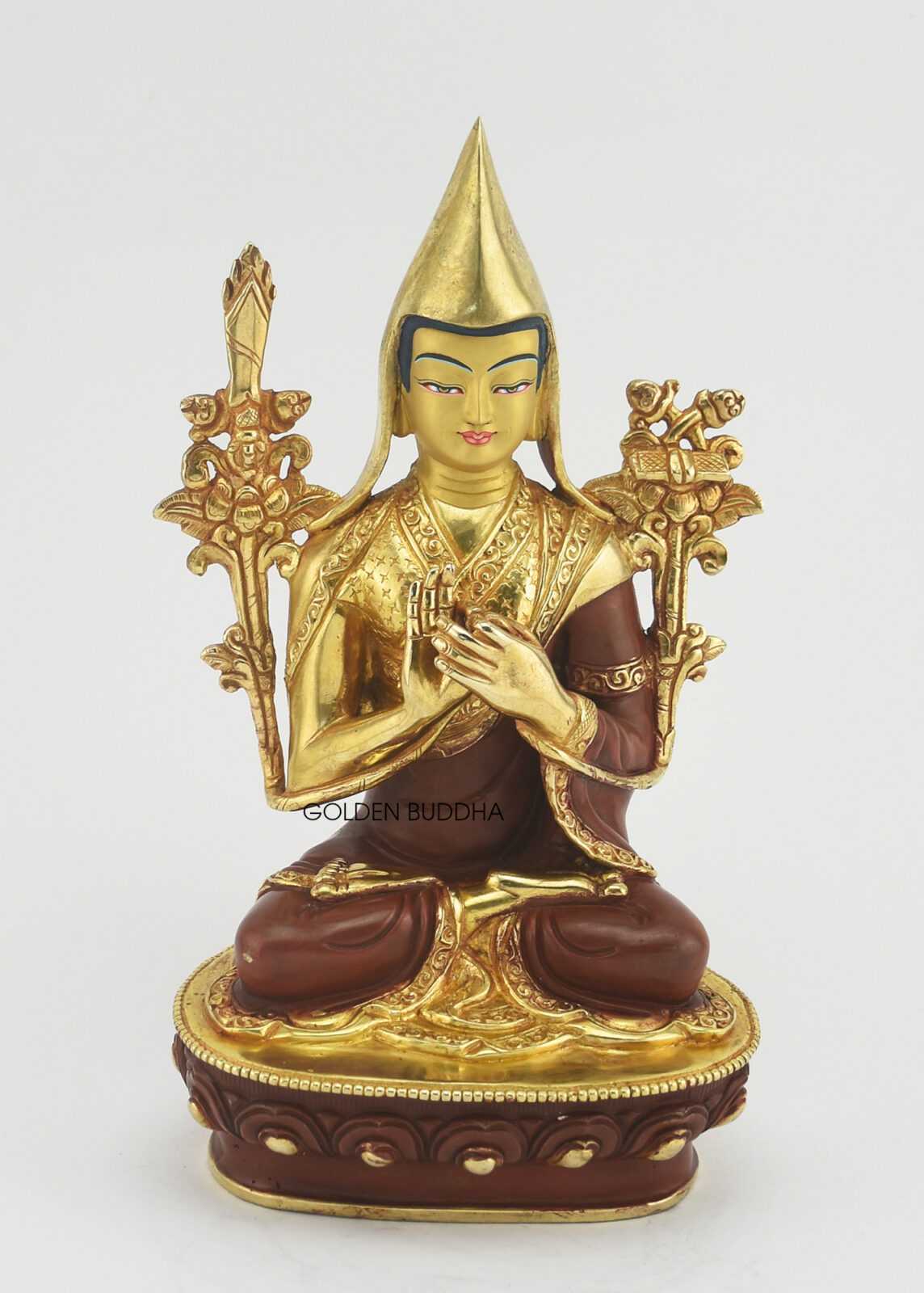
Guru Tsongkhapa Statue 9.25″ | Gelug School Founder, 24K Gold
Nutritive
$ 98.37
This 9.25″ Guru Tsongkhapa statue is partly fire gilded in 24K gold with a hand-painted face, handcrafted in Patan, Nepal by master Newar artisans using the traditional lost wax sculpting method. This is a solo presentation — Tsongkhapa is typically depicted as part of a trio with his two principal disciples, Gyaltsabje and Khedrubje, but this statue presents him alone, suited to an altar where the full trio is not required or where a single teacher figure is preferred. Learn more about Guru Tsongkhapa’s iconography and symbolism in our complete guide to Tibetan Guru statues.Guru Tsongkhapa (1357–1419 CE) is the founding father of the Gelug school of Tibetan Buddhism and is revered as an emanation of Manjushri — the Bodhisattva of Wisdom — appearing in human form to revitalize the teachings of the Buddha in Tibet. Tibetan Buddhist tradition holds that Shakyamuni Buddha prophesied Tsongkhapa’s coming: that a being would appear in the Land of the Snows in the form of an ordinary monk, establish a “joyful land” from which the Dharma would spread, and serve as its protector. The joyful land is Ganden Monastery (dGa’-ldan, “Joyful”) — founded by Tsongkhapa in 1409 CE on a mountain near Lhasa — which became the mother monastery of the Gelug tradition, a school that remains central to Tibetan Buddhism today under the spiritual leadership of the 14th Dalai Lama.Symbolism of a Guru Tsongkhapa StatueTsongkhapa is depicted wearing the distinctive yellow pandita hat of the Gelug school — the pointed scholar’s hat inherited from the great Indian Buddhist monastic university tradition, yellow signifying his role as a master of both sutra and tantra within the Gelug lineage — and the robes of a fully ordained Buddhist monk. He displays the Dharmachakra mudra — the Wheel of Dharma gesture, both hands held before the heart — the mudra originally displayed by Shakyamuni Buddha at his first teaching at Sarnath, signifying Tsongkhapa’s role as a great teacher who turned the wheel of the Dharma anew in Tibet. Two lotus flowers rise over his shoulders: the lotus over his left shoulder holds the Prajnaparamita Sutra — the scripture of perfected wisdom, the foundational text of Mahayana Buddhist philosophy — and the lotus over his right shoulder bears the sword of wisdom, Manjushri’s emblem, affirming Tsongkhapa’s identity as Manjushri’s human emanation. Together these two attributes declare what Tsongkhapa embodies: the perfected wisdom of the sutras and the cutting clarity of direct realization.When depicted in the traditional trio, Tsongkhapa is flanked by Gyaltsabje and Khedrubje — emanations of Avalokiteshvara (compassion) and Vajrapani (power) respectively. Certificate of authenticity Authentic, Handmade in Nepal Every statue and ritual item is handcrafted in Patan, Nepal, using traditional lost wax casting and comes with a certificate of authenticity issued by Nepal's Department of Archaeology, verifying its materials, technique, and origin. Learn more about our certification